Choosing internet security services for a hybrid team means looking beyond antivirus licences and an office firewall. Staff need protection when they open email at home, access cloud applications on the move and share documents with external partners. Your provider must also explain who investigates alerts, who can contain an attack and how the business recovers. This guide gives UK SMEs a practical way to compare that coverage before signing a contract.
Start with your working arrangements
Before requesting quotes, prepare a short inventory of how your team works. Headcount alone will not tell a provider what needs protecting.
Record these essentials:
- People and access: Employees, contractors, administrators and anyone joining or leaving soon.
- Devices: Business laptops, personal devices, mobiles and operating systems still in use.
- Applications and data: Microsoft 365, finance systems, customer records and sensitive shared files.
- Locations and connections: Offices, homes, shared workspaces and remote access to on-site systems.
- Business dependencies: Processes that cannot tolerate extended downtime, plus customer or regulatory requirements.
Give each shortlisted provider the same inventory. Ask them to identify unsupported systems, unmanaged devices and assumptions behind their quote. This makes proposals easier to compare and exposes gaps before they become contractual disputes.
What should internet security services include?
Consumer security software mainly protects an individual device or household. Business services should coordinate protection across users, devices and applications, with clear responsibilities for managing it. Buying software alone does not necessarily include monitoring or incident response.
Use this table to check the proposed scope.
| Protection area | What to look for | Evidence to request |
|---|---|---|
| Identity and access | Multi-factor authentication, restricted administrator access and prompt leaver removal | An example access policy and offboarding process |
| Endpoint protection | Centrally managed protection, encryption and updates for supported devices | A device coverage report and patching responsibilities |
| Email and web security | Controls against malicious links, attachments and fraudulent messages | Details of configuration, alert handling and exclusions |
| Cloud applications | Secure configuration, controlled sharing and useful audit logs | A sample configuration review |
| Detection and response | Investigation, escalation and authorised containment | Monitoring hours and a written response procedure |
| Backup and recovery | Appropriate backup separation and tested restoration | A recent example of a restore-test report |
Not every business needs every available security product. The important distinction is between a capability being licensed, configured and actively operated. Ask who checks that each control remains effective after users change roles or new applications arrive.
A provider should also identify what is excluded. Website hosting, specialist applications and older equipment may sit outside its standard package, even when the proposal promises broad business protection.
Check that protection follows people outside the office
For hybrid teams, internet security services must protect users and devices without depending entirely on traffic passing through the office network. Ask which controls still work when a laptop connects directly to a home router or mobile hotspot.
A practical demonstration is more useful than a product brochure. Have the provider explain how it would handle a missing laptop, an overdue security update and an employee signing in from an unfamiliar device. Look for central visibility, enforceable policies and a workable route for resolving problems without leaving staff unable to work.
For sensitive access, ask about phishing-resistant multi-factor authentication where supported, particularly for administrators. Check whether access can be restricted when a device is unmanaged or fails security requirements. A VPN can protect a connection to business systems, but it does not replace device security or identity checks.
Personal devices need an explicit policy. Establish what business information may be stored, what the employer can see and what can be removed remotely. Staff should understand these boundaries before enrolling a device.
CIS explains the underlying controls in its guide to cloud-based security for devices outside the office. During procurement, focus on whether the proposed service actually configures and maintains those controls for your working arrangements.
Test external collaboration, not just employee logins
When comparing internet security services, include a real example of how your team exchanges information with customers, suppliers or contractors. Internal access can be well controlled while external sharing remains poorly managed.
For example, an engineering SME might have home-based designers exchanging drawings with a specialist manufacturer such as Jakom, a shafts and rollers producer. That workflow raises practical questions: who can open the drawings, can recipients forward access and how is permission removed when the project ends?
Ask a prospective provider to demonstrate a controlled sharing process using test files. It should accommodate legitimate collaboration without making unrestricted links or personal email accounts the easiest option. Check whether access can expire and whether useful activity records are available if something goes wrong.
Where a supplier needs remote access to equipment, treat that separately from document sharing. Require named accounts, limited permissions and a defined access window. Office security software should not be assumed to protect industrial machinery or specialist operational systems.
This exercise reveals whether a provider understands your business processes. It also gives you a concrete acceptance test for the eventual service, rather than relying on a general promise to keep data safe.
Verify the provider behind the proposal
A credible supplier should be able to explain how its own organisation is secured and how its delivery arrangements work. For internet security services, a UK postal address alone tells you little about where support, monitoring or data processing happens.
Ask which legal entity will contract with you, where the people handling alerts are based and whether subcontractors are involved. Establish where security logs are stored, who can access them and what safeguards apply to any transfers of personal data outside the UK. UK hosting by itself does not establish compliance with UK GDPR.
Certifications can support due diligence, but their scope matters. The NCSC’s Cyber Essentials scheme covers a baseline of technical controls. It is not evidence that a supplier provides continuous monitoring or a particular incident response capability. For ISO 27001, inspect the certificate’s scope, legal entity and validity rather than accepting a logo in a presentation.
Request a reference from an organisation with comparable working arrangements. A relevant conversation should cover onboarding, communication during incidents and how the provider handles recurring problems, not simply whether its helpdesk is friendly.
Finally, ask for sample reports with customer information removed. Useful reports distinguish unresolved risks from completed tasks and identify who must act next. A dashboard full of blocked threats does not tell you whether a serious configuration gap remains open.
Agree what happens when an alert becomes an incident
Detection is only one part of the service. The real test of internet security services is whether someone can investigate and act quickly enough to limit harm, including outside normal office hours.
Distinguish monitoring hours, helpdesk hours and incident response availability. A system may collect alerts continuously while people review them only during business hours. Likewise, an acknowledgement target is not a commitment to contain an attack or restore operations.
Use a specific scenario: a home-based employee’s laptop shows signs of ransomware at 8 pm on Friday. Ask who reviews the alert, who may isolate the device and who contacts your nominated decision-maker. Agree what happens if that person does not answer. Record which containment actions are pre-authorised and which require approval.
Recovery needs equally clear ownership. Establish acceptable downtime and data loss for important systems, then ask how the proposed backup and recovery arrangements support those requirements. Request evidence of restoration tests, including relevant cloud data. Retention settings and synchronisation are not automatically substitutes for a recoverable backup.
Where a personal data breach must be reported, the ICO’s breach-reporting guidance explains the applicable notification requirements, including the 72-hour timeframe where feasible. Your supplier’s escalation process must leave your organisation time to assess its obligations. Do not assume the provider will make regulatory notifications on your behalf.
Compare total cost and responsibility
Quotes for internet security services are only comparable when their assumptions match. A low per-user price may exclude devices, cloud backup, onboarding or the work needed after a serious incident.
Ask each supplier to price the same environment and explain how charges change as employees or devices are added. Separate recurring service fees from initial remediation, migration and configuration work. Identify any minimum commitments and products licensed through a third party.
Incident-related costs deserve particular attention. Does the contract include investigation and containment, or only notification? Are specialist forensics, data restoration and out-of-hours engineering charged separately? There is no universal right commercial model, but the limits must be visible before an emergency.
Responsibility matters as much as price. If you have an internal IT manager, agree who patches systems, approves access, maintains backups and follows up security findings. CIS’s guide to managed services alongside an internal IT team explains why these handovers need explicit ownership.
Check the exit arrangements too. Your organisation should understand how it retains control of administrator accounts, retrieves relevant records and transfers management to another supplier. Ask what happens to installed security tools when the contract ends and how any transition charges are calculated.
A slightly higher quote may represent better value if it includes necessary operational work. Conversely, extra products add little value if nobody is responsible for configuring or reviewing them.
Use a shortlist scorecard and a demonstration
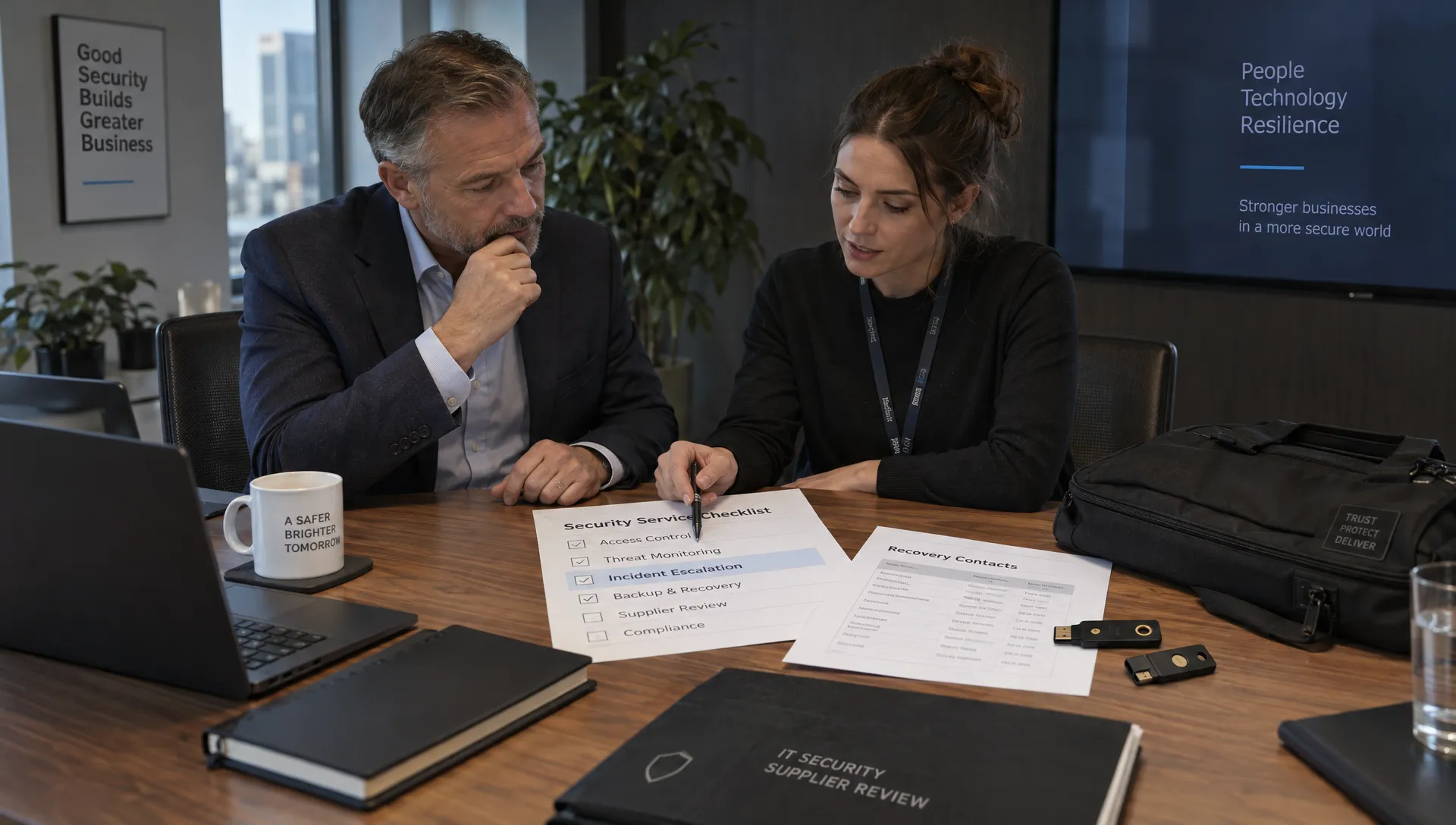
Before ranking internet security services, reject proposals that leave a critical requirement unaddressed. Missing coverage for a core operating system or no workable incident escalation should not be offset by a strong sales presentation.
For the remaining suppliers, use a simple internal scoring method: 0 for no evidence, 1 for a partial answer and 2 for demonstrated capability. These are suggested procurement scores, not an industry certification.
| Decision area | What a strong answer demonstrates |
|---|---|
| Hybrid coverage | Protection remains effective away from the office and unmanaged access is controlled |
| Operational ownership | Named responsibilities exist for configuration, updates, alerts and follow-up |
| Incident handling | Coverage hours, containment authority and escalation routes are documented |
| Recovery | Restoration has been tested against relevant business requirements |
| Commercial transparency | Exclusions, variable charges and exit arrangements are understandable |
Weight the areas according to your business. A firm handling sensitive client records may place particular emphasis on access control and auditability. A business dependent on a small number of operational systems may prioritise restoration and specialist support.
Before signing, request a walkthrough using three scenarios: a lost laptop, a departing employee and a suspicious sign-in outside office hours. Agree an onboarding plan that records existing gaps, assigns owners and defines how completion will be verified. Keep the scorecard and demonstrations as evidence supporting your decision.
Frequently asked questions
Are internet security services necessary if we already use Microsoft 365? Microsoft 365 includes security capabilities, with availability depending on your licences. Those capabilities still need appropriate configuration, monitoring and maintenance. Check which responsibilities your team can fulfil internally before paying for additional tools or managed support.
Can free security tools protect a small hybrid team? Free and built-in tools can provide useful protection. The issue is not price alone, but whether your business has suitable coverage, central management, support and someone accountable for responding. Check business-use licensing and limitations before relying on a free product across company devices.
Does every SME need 24-hour monitoring? Not necessarily. The decision depends on the impact of an incident outside working hours, your exposure and your ability to respond internally. If you buy continuous monitoring, confirm whether it includes human investigation and authorised containment rather than automated alerts alone.
Should penetration testing be included in the contract? Its value depends on your systems, risks and customer obligations. Ask what is being tested, how often and who fixes the findings. An automated vulnerability scan and a scoped penetration test are not interchangeable. Neither replaces routine updates, secure configuration or ongoing monitoring.
Build your brief before requesting a proposal
The best internet security services for your hybrid team will fit how people work, make responsibilities explicit and provide evidence that protection and recovery arrangements operate as intended.
Start with your inventory, identify the business processes you cannot afford to lose and use the same questions with every supplier. CIS provides managed IT support, cybersecurity, cloud services and backup and recovery planning for UK organisations. Speak to CIS about your working arrangements, existing controls and the gaps you want a service to address.