Growth can expose gaps that were easy to overlook when everyone worked in one office and knew every supplier. A practical review of cyber security problems and solutions helps growing SMEs decide what to fix first, who owns each action and how to check that protection works.
The priority is not buying every available security tool. It is protecting payments, keeping essential services running and ensuring that new people, devices and applications do not introduce unmanaged risks. These seven areas provide a useful starting point.
1. Phishing and payment fraud
A convincing email can persuade someone to disclose a password, open a malicious attachment or change a supplier’s bank details. Growing businesses are particularly exposed when new starters do not yet know colleagues, suppliers or approval procedures.
The consequences extend beyond an infected computer. A compromised mailbox can reveal customer conversations, support invoice fraud and give an attacker a credible identity for further messages.
The solution: Combine email filtering with a payment verification process. Confirm new or changed bank details using a trusted telephone number already held on file, not contact details supplied in the request. Require a second approver for sensitive payments.
Give staff an obvious way to report suspicious messages without fear of blame. Short, role-specific exercises are more useful than expecting everyone to remember an annual presentation. CIS explains the practical topics to cover in its guide to cyber security training for small businesses.
A finance team’s approach to cyber security problems and solutions should therefore cover payment procedures as well as email protection. Test whether someone can report an urgent-looking fraudulent request before money leaves the business.
2. Weak accounts and access that grows unchecked
Shared passwords, forgotten contractor accounts and unnecessary administrator rights become harder to track as headcount increases. One compromised account can provide access to far more information than its owner needs.
The solution: Require multi-factor authentication (MFA), starting with email, remote access and administrator accounts. Prefer phishing-resistant methods, such as passkeys or security keys, where supported. Use a business password manager for unique credentials and avoid shared user accounts wherever possible.
Apply least privilege: staff should receive the access required for their role, rather than broad permissions copied from a colleague. Keep administrator accounts separate from everyday email and browsing accounts.
Make joiner, mover and leaver checks part of normal employment processes. A department manager should approve access, while IT should disable accounts, revoke active sessions and recover devices when someone leaves. Role changes also need a review because old permissions often remain in place.
When reviewing cyber security problems and solutions during recruitment, give access removal the same attention as account creation. A useful check is whether you can identify every active account, its owner and its business purpose.
3. Unpatched software and forgotten devices
A business cannot maintain equipment it does not know exists. Older servers, meeting-room systems, printers and internet-connected devices can remain operational long after responsibility for them becomes unclear.
The risk is not simply that software is old. Unsupported products may no longer receive security fixes, while exposed services can give attackers a route into other systems.
The solution: Maintain an asset register covering hardware, operating systems, applications and cloud services. Record who owns each asset, whether it is supported and whether it is accessible from the internet.
Prioritise updates according to exposure and potential impact. An actively exploited vulnerability on an internet-facing firewall needs faster attention than a routine update on an isolated device. Where immediate patching is impossible, document temporary safeguards and set a replacement or remediation deadline.
An asset register connects cyber security problems and solutions to named owners, rather than leaving vulnerable equipment outside anyone’s remit. Check that updates actually install, not merely that deployment was scheduled.
Separate guest Wi-Fi and less-trusted devices from sensitive systems. CIS’s guidance on strengthening business network security explores supporting controls such as firewalls, access restrictions and network maintenance.
4. Ransomware and backups that cannot restore operations
Ransomware can interrupt trading, halt production or prevent staff accessing customer records. Attackers may also steal information before encrypting systems, so restoring files does not necessarily resolve the whole incident.
The solution: Combine endpoint protection, restricted administrator access and network separation with independently protected backups. Keep at least one backup copy offline or otherwise protected against alteration by compromised production accounts.
Define two business requirements: how much data you can afford to lose and how long each service can remain unavailable. Payroll, order processing and archived marketing files may need different recovery arrangements.
Within your cyber security problems and solutions plan, recovery needs its own budget and test schedule. Restore a representative service into an isolated environment and check that staff can actually use it. Record the time taken, missing dependencies and any credentials required.
Do not assume that cloud synchronisation, a recycle bin or standard retention settings provide the recovery capability your business needs. Assess the available features against accidental deletion, account compromise and a wider service disruption.
Give backup responsibility to a named person and retain evidence of successful restores. A green backup dashboard confirms that a job completed; it does not prove that the business can resume work.
5. Cloud sprawl and exposed personal information
Teams often adopt file-sharing services, collaboration platforms and AI tools faster than IT can review them. Customer records may end up in personal accounts, public sharing links or applications with unsuitable contractual terms.
Cloud-related cyber security problems and solutions often centre on controlling who can share information, with whom and for how long. Moving data to a recognised platform does not remove the need to configure access properly.
The solution: Establish an approved application process that is quick enough for staff to use. Review permissions, external sharing, data locations and supplier terms before sensitive information is uploaded. Set clear rules for entering business or personal data into public AI services.
Apply additional checks to identity documents and financial information. For example, SMEs arranging overseas travel can use these security checks for electronic visa applications to help staff verify portals and protect passport details during applications.
Assign responsibility for reviewing shared links and removing access when projects finish. Retain personal information only for a justified period, rather than indefinitely because storage is available. Encryption helps protect data, but it does not prevent someone with legitimate access from sharing it inappropriately.
6. Supplier access and dependencies nobody owns
An outsourced payroll service, software vendor or maintenance contractor can become part of your security exposure. Suppliers may hold sensitive information, connect remotely or provide a service that your business cannot operate without.
Supplier risk includes both compromise and disruption. Even without a data breach, an unavailable platform can stop orders, appointments or payments.
The solution: Keep a register of critical suppliers and document what they access, what data they hold and what happens if their service fails. Due diligence should be proportionate to that impact, rather than identical for every purchase.
For suppliers with remote access, require named accounts, MFA and access limited to the necessary systems. Where practical, enable access only when required. Agree incident notification arrangements, responsibilities and a route for escalating urgent issues.
Bring supplier access into your cyber security problems and solutions review before granting connections to production systems. Ask who removes that access when the contract ends.
For essential services, identify a workable fallback. This might mean a controlled manual process or an alternative communication channel. Do not assume that the supplier’s recovery arrangements meet your own deadlines without checking them.
7. Missed warning signs and an untested incident response
Security alerts are useful only if someone reviews them and can act. In a growing SME, responsibility can fall between an internal IT lead, an outsourced provider and individual application owners.
The solution: Agree which alerts are monitored, who investigates them and what happens outside normal working hours. Prioritise signals such as unexpected administrator activity, suspicious sign-ins and changes to backup settings. Confirm what monitoring arrangements actually cover rather than assuming every service is included.
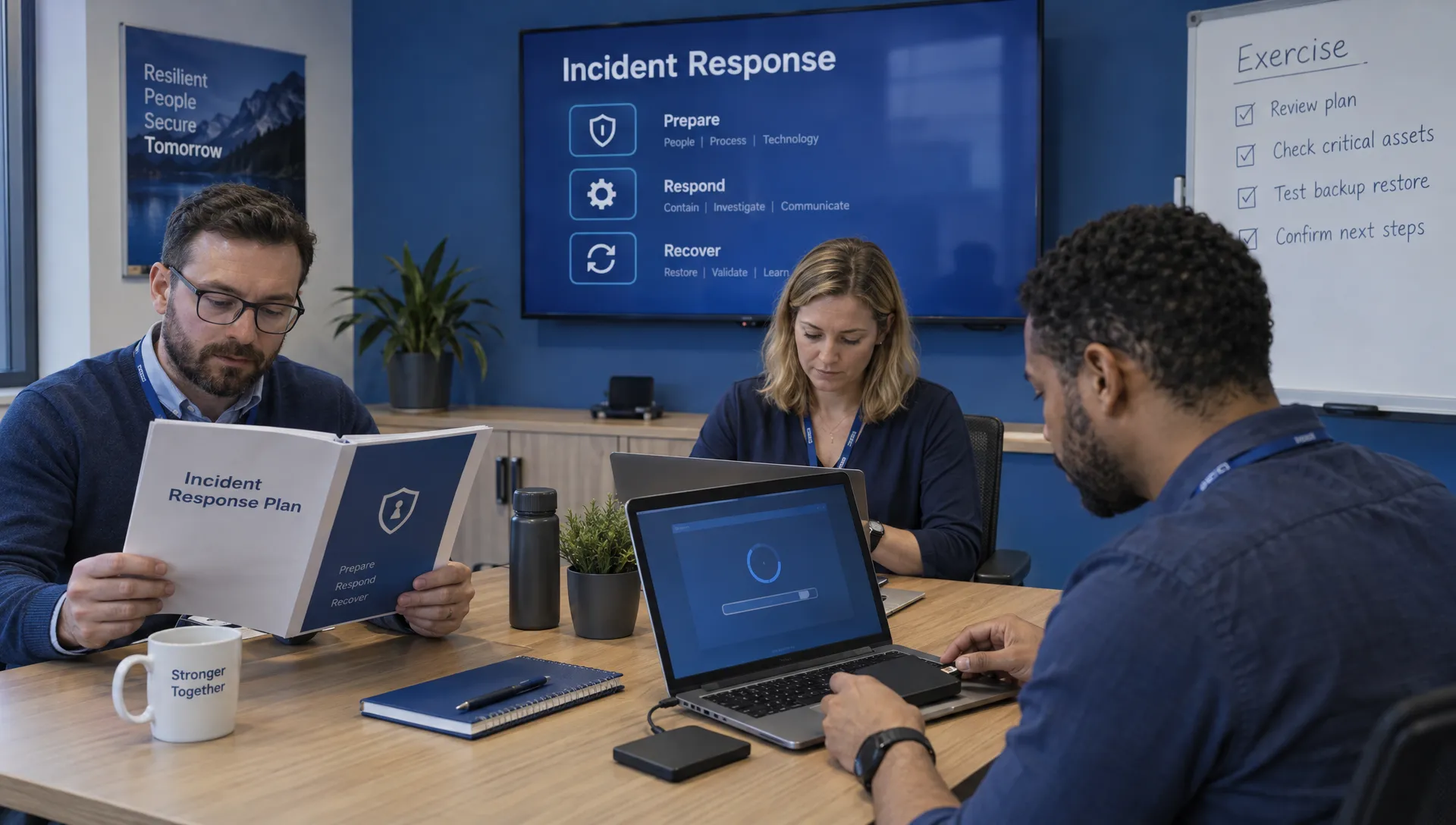
Prepare a short incident response plan with named decision-makers, alternative contact details and authority to isolate affected equipment. Include IT, a senior business lead and responsibility for customer communications. Keep a copy accessible if email and shared drives are unavailable.
Know your UK breach-reporting responsibilities
Under UK GDPR, a personal data breach must be reported to the ICO without undue delay and, where feasible, within 72 hours of becoming aware of it, unless it is unlikely to result in a risk to people’s rights and freedoms. High-risk breaches also require affected individuals to be informed without undue delay.
The ICO’s personal data breach guidance explains the assessment and reporting process. Document breaches and decisions even where notification is not required. Contractual or sector-specific duties may apply too.
Run a tabletop exercise involving a compromised mailbox or unavailable accounting system. Test decisions, evidence preservation and communications, not just technical recovery.
Prioritising cyber security problems and solutions on an SME budget
Start with the systems that move money, hold sensitive information or keep customers served. Business impact should determine priorities, not the length of a vendor’s feature list.
| Available resources | First focus | Evidence to request |
|---|---|---|
| No dedicated internal IT team | Protect email, remote access and backups; identify an accountable provider or technical contact | MFA coverage, a current asset list and a successful restore record |
| Small internal IT team | Standardise devices, automate routine updates and formalise access reviews | Unsupported-system register, patch exceptions and leaver checks |
| Multiple sites or business units | Coordinate monitoring, supplier assurance and recovery across teams | Clear escalation coverage, tested dependencies and incident exercise findings |
Fix urgent exposures immediately. Then create a 30-day action list and a longer improvement plan, with an owner and completion evidence for each item.
Use measures that demonstrate reduced exposure: fewer unsupported devices, no unexplained administrator accounts and restores completed within agreed business deadlines. Buying another tool is not, by itself, evidence that a risk has been addressed.
Frequently asked questions
Who should own cyber security problems and solutions in an SME? A senior business leader should remain accountable for risk decisions and funding. Internal IT or a managed provider can operate controls, while finance, HR and department managers own the processes that depend on them. Document those responsibilities so important actions do not fall between teams.
Is phishing responsible for 90% of cyber attacks? Do not treat that figure as a universal fact. Percentages vary according to the dataset, reporting period and whether the source counts attempts, incidents or confirmed breaches. Prioritise phishing protection without overlooking exposed systems, stolen credentials or supplier compromise.
Is Cyber Essentials enough? The UK’s Cyber Essentials scheme provides a useful baseline of technical controls. It does not replace business-specific risk assessment, tested recovery or incident preparation. Use it as a foundation and assess additional requirements arising from your information, customers and sector.
Build a practical improvement plan with CIS
CIS provides managed and co-managed IT support, cyber security, Microsoft 365 and cloud services for UK organisations. If growth has made responsibilities unclear, speak to CIS about reviewing your current position and planning improvements. Bring your critical systems list, recent security concerns and recovery requirements so the discussion starts with business needs rather than a shopping list of products.