IT disaster recovery testing proves whether your organisation can restore usable services after an outage, cyberattack or data loss. A backup job marked “successful” is not enough. The test needs to show that people can recover the right systems, within agreed limits, without introducing unacceptable risks.
For an SME, the most useful result is a clear answer: can staff resume essential work, with sufficiently current and trustworthy data? This guide explains how to define that answer, choose an appropriate test, protect production systems and record evidence that supports a defensible pass or fail.
What counts as a successful recovery test?
A successful test restores an agreed business service within its recovery targets, verifies its data and security, and produces evidence that someone accountable accepts. Starting a server or opening a restored folder proves only part of that.
Consider an order-processing system. The database might restore correctly, but the service is not operational if staff cannot sign in, stock information is unavailable or orders cannot reach the warehouse. Recovery must reach the point where the business can perform its agreed essential tasks.
Success also depends on scope. A file restoration can pass its own checks without proving that the entire organisation could recover from ransomware. Every result should state what was tested, which conditions were simulated and what remains unproven.
Finding weaknesses is useful, but it does not turn a missed target into a pass. Record the failure, assign corrective work and retest. That distinction prevents a reassuring exercise report from hiding an unresolved business risk.
Set pass/fail criteria for IT disaster recovery testing
Agree the acceptance criteria before starting. Otherwise, teams can unconsciously redefine success around whatever they managed to recover.
The two central measures are the recovery time objective (RTO) and recovery point objective (RPO). RTO defines the targeted time to restore an agreed level of service. RPO defines the acceptable data-loss window, measured backwards from the disruption.
Use business tasks to make both meaningful:
| Criterion | Illustrative acceptance requirement | Evidence to retain |
|---|---|---|
| Recovery time | Order processing resumes within four hours of the simulated disruption | Event timeline and business acceptance time |
| Data loss | Recovered transactions are no more than one hour behind the disruption | Validated transaction timestamps |
| Functionality | An authorised user completes an order through to warehouse receipt | Test transaction and user sign-off |
| Security | Required access controls and logging operate in the recovered environment | Configuration checks and log samples |
| Performance | The service supports an agreed minimum workload | Measured workload results |
These figures are examples, not recommended targets for every business. Set your own limits according to operational needs, customer commitments and recovery costs.
Define the clock precisely. If your RTO begins when service is lost, do not start measuring only when an engineer begins the restore. Include detection, escalation and recovery decisions, or explicitly identify those stages as outside the exercise.
If those objectives are not documented yet, CIS’s backup and disaster recovery planning guide provides the wider planning context.
Choose a test method that proves your claim
Different exercises answer different questions. IT disaster recovery testing should use the least disruptive method capable of proving the specific recovery claim, rather than selecting a dramatic scenario for its own sake.
| Method | What it can demonstrate | What it cannot establish alone |
|---|---|---|
| Tabletop walkthrough | Roles, decisions, escalation routes and gaps in the plan | Actual restoration times or technical recoverability |
| Isolated restore | Backup usability, recovery steps and selected application checks | Full production performance or live dependencies |
| Parallel recovery | Operation of a recovered service alongside production, with appropriate isolation | The complete impact of switching real users |
| Controlled failover and failback | Transfer to a recovery environment and return to normal operation | Readiness for every incident scenario |
A tabletop walkthrough brings representatives from IT, operations, finance, customer service and other relevant departments together to work through an incident. Give participants decisions to make, rather than simply reading the plan aloud.
The decision-and-feedback approach used in business simulations for management training offers a useful model for involving participants. However, a discussion-based exercise is not evidence that an IT service can actually recover.
Build confidence progressively. Resolve obvious coordination gaps before attempting live failover, then increase technical realism as the recovery process becomes safer and more repeatable. Keep the limitations of each method in the final report.
Build the scenario around a business service
Start with a process such as taking payments, dispatching goods or accessing client records. Identify the applications, data and people needed to perform its minimum acceptable version.
For useful IT disaster recovery testing, the scenario must explain what has failed and what remains available. “The server is down” leaves too many assumptions unstated. A stronger scenario specifies that the primary site is unavailable, the normal administrator is absent and staff must work remotely.
Choose scenarios according to your risks. Accidental deletion tests a different recovery path from ransomware. A cloud service outage might require a temporary business workaround rather than a restoration under your control.
For a suspected compromise, include selection of a recovery point believed to predate the attack, investigation of its suitability and checks before reconnection. Restoring quickly from a compromised backup is not successful recovery.
Also define exclusions honestly. If the exercise assumes working internet access or an available supplier, record that assumption. Those conditions can become separate scenarios later rather than silently disappearing from the recovery risk assessment.
Test dependencies that are easy to overlook
An application depends on more than its own backup. IT disaster recovery testing must check the services required to authenticate users, decrypt data, find systems and exchange information.
Map identity providers, multifactor authentication, privileged accounts, encryption keys, DNS, network connectivity and certificates. Include external dependencies such as payment processors, managed service providers and software suppliers.
Look for circular dependencies. Recovery instructions stored only in an unavailable document platform are inaccessible when needed. An administrator who needs the failed identity service to access the backup console may be unable to begin recovery.
For Microsoft 365 and other cloud services, establish which recovery actions belong to your organisation and which depend on the provider. Test your actual permissions, backup coverage and recovery options rather than assuming that cloud availability guarantees recovery of deleted or damaged business data.
Use controlled emergency access arrangements where necessary, and verify that their use is authorised, monitored and reviewed afterwards.
Protect production before testing recovery
A recovery exercise should not become the outage it was intended to prevent. IT disaster recovery testing needs written authorisation, clear boundaries and a named person who can stop the exercise.
Before any technical activity, confirm these safeguards:
- Isolation: Recovered systems cannot accidentally contact production databases, send customer messages or submit real payments.
- Data protection: Test data is minimised or masked where practical, with access and retention controls appropriate to its sensitivity.
- Rollback: The team knows how to reverse changes, including network, DNS and identity configuration changes.
- Stop conditions: Unexpected production impact, suspected contamination or loss of control triggers an immediate pause.
- Supplier coordination: Relevant providers know the scope, timing and responsibilities, with approval where their terms require it.
For isolated restores, check scheduled jobs, integrations and outbound connections before starting the recovered application. A duplicate system can still cause harm if it sends genuine invoices or overwrites live information.
For live failover, define how writes will be controlled and reconciled. Returning to the original environment without a data synchronisation plan can lose transactions created during the test.
Never introduce live malware to make a scenario realistic. Simulate the consequences within a controlled environment instead. Preserve the original backups and recovery options throughout the exercise.
Run the test as a timed business exercise
Use an exercise controller to introduce events and maintain the timeline. A technical lead manages recovery activity, while a business representative decides whether the restored service is usable.
During IT disaster recovery testing, record when the simulated disruption begins, when it is detected, when recovery is authorised and when each dependency becomes available. Capture the point at which the business accepts the service, not merely when the infrastructure starts.
Follow the documented recovery instructions. If an engineer succeeds through undocumented knowledge, note the workaround and update the instructions afterwards. That result may expose dependence on one individual even when the technical target is met.
Ask an ordinary authorised user to complete a representative task. Depending on the service, this could involve creating an order, retrieving a client record or generating a financial report. Check downstream receipt and audit records as well as the screen in front of the user.
Include communication in the exercise. Verify that remote staff can receive instructions without relying solely on the affected platform. Provide an accessible alternative for anyone who cannot use the primary channel, and test who approves customer updates.
Finally, complete failback or controlled teardown. Confirm that temporary access has been removed, test integrations are disabled and normal monitoring is functioning. Recovery is incomplete if the exercise leaves an unmanaged environment behind.
Measure recovery time and data loss against real work
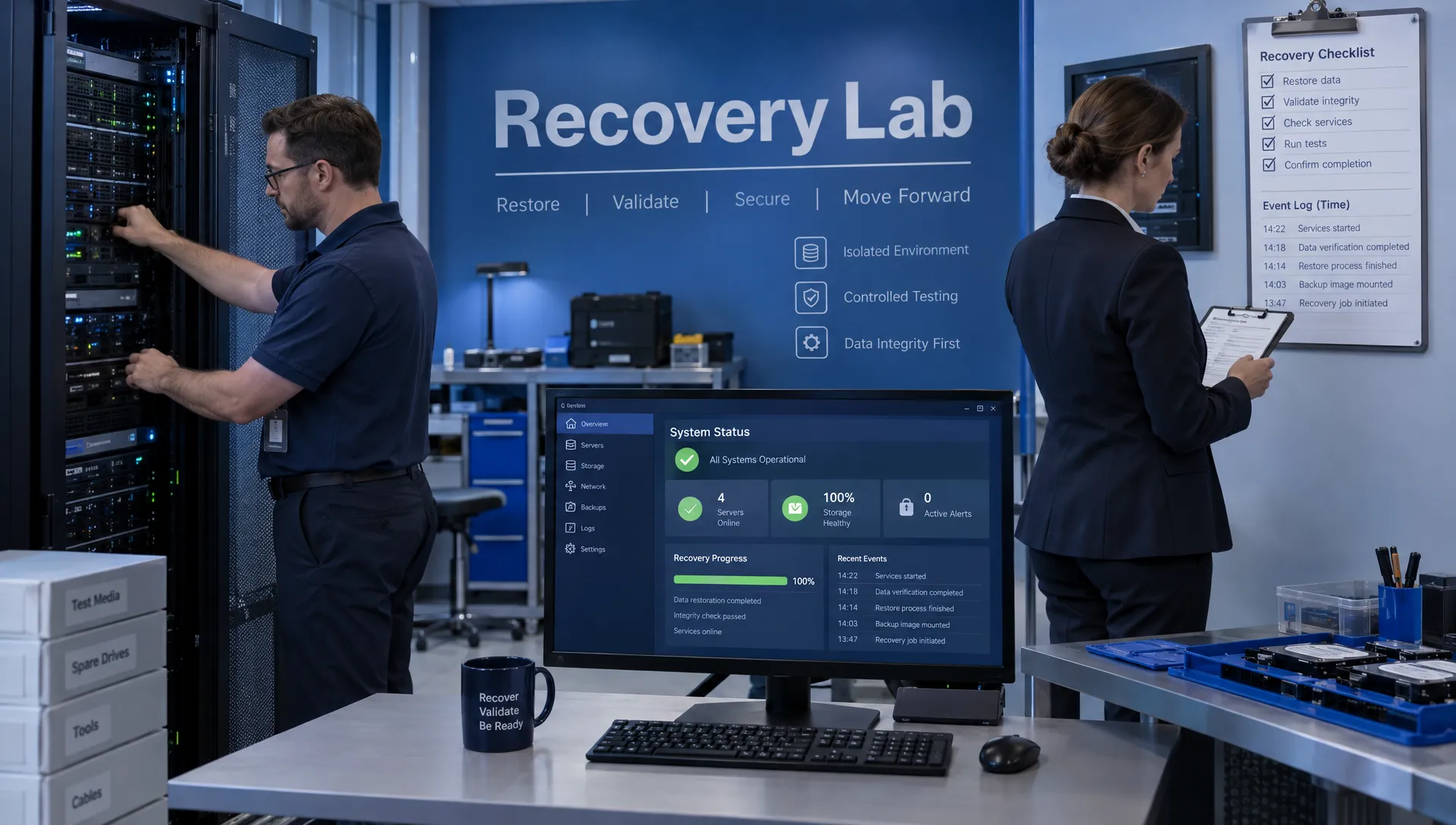
Suppose a simulated outage begins at 09:00. The application starts at 11:20, but users cannot authenticate until 11:45 and a test order reaches the warehouse at 12:10. If that completed workflow defines minimum service, recovery took three hours and ten minutes, not two hours and twenty minutes.
IT disaster recovery testing should compare that result with the agreed RTO and explain any excluded stages. A pre-staged environment can provide useful evidence, but do not describe its result as an end-to-end recovery time if provisioning was omitted.
RPO needs equally careful measurement. If the disruption occurs at 09:00 and the latest verified recovered transaction is from 08:15, the demonstrated data-loss window is 45 minutes. A backup job timestamp alone does not establish this: its contents must be checked.
Validate transaction consistency, missing records, duplicate processing and links between systems. An order database and payment system restored to incompatible points may require reconciliation before work resumes.
Measure usable capacity too. A service that accepts one test user may still fail under the minimum workload required by the business. Where a load test is outside scope, state that limitation rather than claiming production readiness.
Record a verdict that matches the evidence
The report should distinguish a pass, a failed objective and an area that was not tested. IT disaster recovery testing loses value when all three are summarised as “completed successfully”.
Pass: The agreed criteria were met, with evidence supporting technical recovery and business acceptance. Minor observations may remain, provided they do not undermine those criteria.
Fail: At least one required criterion was missed, or a safety or integrity issue made the result unacceptable. Record what happened without softening the result because the team worked hard.
Not demonstrated: The exercise did not test a particular capability. For example, an isolated restore does not demonstrate that live users can be switched safely to the recovered system.
Retain the scenario, scope, participants, timings, relevant logs, validation results and sign-offs. Protect this material because it can reveal sensitive infrastructure details. Avoid retaining credentials or unnecessary personal data in screenshots.
Every material finding needs an owner, a completion date and a retest requirement. For example: “Operations manager to approve an alternative dispatch process, then demonstrate it during the next exercise.” A general instruction to improve resilience is not an actionable outcome.
How often should recovery tests happen?
There is no single timetable that suits every SME. Base IT disaster recovery testing frequency on service criticality, change, incident history and applicable obligations.
A practical programme can combine frequent checks on selected restores, periodic cross-department exercises and broader technical recovery tests at intervals justified by risk. Do not present an annual exercise as sufficient merely because it is convenient.
Retest after material changes, such as replacing backup software, moving an application to the cloud, changing identity systems or appointing a different recovery supplier. A test performed before those changes may no longer support your recovery assumptions.
Repeat failed elements after corrective work, rather than waiting for the next scheduled exercise. Over time, rotate scenarios so that site loss, data corruption, account compromise and supplier unavailability receive appropriate attention.
Keep recovery assurance distinct from vulnerability assessment. CIS’s explanation of security testing methods helps separate recovery exercises from scanning and penetration testing, which address different questions.
Match the evidence to UK obligations
Under Article 32 of the UK GDPR, appropriate security measures include the ability to restore access to personal data in a timely manner after an incident and a process for regularly testing and evaluating security measures.
That does not prescribe one universal recovery-test schedule or require every organisation to conduct the same exercise. Your approach should reflect the risks, processing activities and measures involved.
IT disaster recovery testing records can help demonstrate how your organisation evaluates recovery arrangements, but a successful exercise is not a certificate of legal compliance. Keep the conclusion proportionate to the scope and evidence.
Check customer contracts, cyber insurance conditions and sector-specific requirements separately. They may specify recovery commitments, reporting requirements or evidence expectations beyond your internal plan. Verify the actual wording rather than assuming that a supplier’s standard report satisfies it.
Agree evidence requirements before the test where possible. A customer may need confirmation that a particular service met its contracted objective, while management needs a prioritised view of unresolved risks. Both should be traceable to the same underlying results.
Frequently asked questions
Is restoring a backup enough to pass a disaster recovery test? Only if the agreed scope is that specific restore. It does not prove that users can access a complete service, dependencies work or recovery targets for the wider business are achievable.
Which exercise brings departments together to review a recovery plan? A tabletop walkthrough brings relevant representatives together to work through a scenario, discuss decisions and identify gaps. It tests coordination and assumptions, but technical restoration needs separate evidence.
Can IT disaster recovery testing happen without interrupting normal work? Many checks can use isolated environments or discussion-based exercises. These reduce disruption but cannot demonstrate every aspect of live failover. Choose the method according to the claim you need to prove.
What should happen if a test fails? Record the missed objective, assess the business exposure and assign corrective work. Introduce temporary safeguards where necessary, then retest the affected capability. Do not close a finding solely because a document has been updated.
Who should sign off the result? The technical lead should confirm the recovery evidence, while the accountable business service owner accepts whether essential work can resume. Include security, data protection or supplier representatives where the scope requires their input.
Make the next test specific and measurable
Start with one critical business service. Define its minimum usable state, recovery targets, dependencies and safety boundaries, then choose a test capable of proving those requirements.
CIS provides business backup and disaster recovery support to help organisations identify critical systems and data and establish recovery objectives. Discuss your existing arrangements and the recovery questions you need to answer, so the next exercise produces evidence you can act on rather than another unchecked assumption.