

Cyber security consulting is worth the investment when your business faces a security decision that its existing team cannot confidently resolve, especially where downtime, sensitive data or customer contracts are at stake. The value comes from better decisions and completed improvements, not the length of the final report.
For a UK SME, that might mean checking security before an acquisition, validating recovery arrangements or working out which weaknesses deserve a limited budget. It does not automatically mean buying an ongoing consultancy retainer. A tightly scoped review may be enough, provided someone has the time and authority to act on its findings.
The business situations that justify outside help
A useful starting point is to identify the decision you need to make. “Are we secure?” is too broad to commission effectively. “Can we restore our order-processing system within the time our business can tolerate?” gives a consultant something concrete to investigate.
| Business situation | Where external expertise can help | Useful deliverable |
|---|---|---|
| A major customer requests security assurance | Check whether your controls support the answers you provide | Evidence-backed responses and a gap-remediation plan |
| You are moving systems or changing ownership | Assess inherited access, data flows and security responsibilities | A prioritised risk assessment before the change |
| Backups exist but recovery is uncertain | Examine dependencies and test restoration | Recorded recovery results and corrective actions |
| Your IT team lacks a particular specialism | Investigate areas such as cloud identity or incident readiness | Technical findings with implementable recommendations |
| You have experienced a security incident | Establish what specialist investigation and recovery support is needed | An agreed response scope and recovery priorities |
| Leadership cannot prioritise competing proposals | Compare risks, existing protections and business impact | A costed improvement roadmap |
The strongest case for cyber security consulting combines a meaningful business consequence with a gap in expertise or independent assurance. A looming deadline can strengthen that case, but urgency alone does not make a vague engagement worthwhile.
If an incident is already under way, distinguish ordinary advisory work from specialist incident response. Check the provider’s response capability, availability and relevant experience before assuming it can investigate a live compromise.
Consultancy, managed security and IT support solve different problems
Consultancy normally addresses a defined question or change. Managed security services provide continuing protection or operational activity. General IT support keeps systems working and may also maintain security controls, depending on the agreement.
For example, a consultant might review Microsoft 365 administrator access and recommend changes. An internal team or managed provider would then implement those changes, maintain accounts and handle subsequent alerts. Do not assume any of those responsibilities are included without checking the contract.
Cyber security consulting can complement an existing IT provider rather than replace it. An external specialist may challenge assumptions, validate a configuration or provide expertise that the day-to-day team does not need permanently.
The handover matters. Before commissioning work, establish who will approve recommendations, make technical changes and maintain the resulting controls. Otherwise, a technically sound assessment can become an expensive document with no operational owner.
Equally, if your main problem is that nobody is patching devices or reviewing security alerts, another assessment may not be the immediate answer. You may need delivery capacity and clear service responsibilities first.
Assess the full cost, not just the consultant’s fee
There is no single meaningful price for a security engagement. Cost depends on the number and complexity of systems, the depth of investigation, access arrangements and the expertise required. A document review and an authorised penetration test are different pieces of work.
Request a proposal that separates discovery, assessment, reporting, remediation support and any retesting. Confirm whether travel, specialist tools or follow-up meetings create additional charges.
The cost of cyber security consulting also includes your own staff time and the changes recommended afterwards. A modest assessment fee can lead to significant implementation work, so reserve budget and capacity for action rather than spending everything on diagnosis.
Compare the full programme cost against credible business consequences: interrupted trading, recovery work, contractual exposure and the effort required to reassure affected customers. These are more useful inputs than a generic claim about the average cost of a breach.
A simple investment example
Suppose a business estimates that two days without its core system would cost £8,000 in lost contribution and disruption, with another £6,000 in external recovery costs. It is considering a £6,000 programme covering an assessment and agreed improvements.
Those figures are illustrative, not CIS prices or market benchmarks. They show that one avoided disruption could exceed the programme cost, but they do not prove that an incident will happen or that the proposed work will prevent it.
The decision should also consider likelihood, uncertainty and alternatives. Testing recovery may offer more immediate value than replacing a functioning security product. Ask the provider to explain which risk each recommendation reduces and why that action should come before other available options.
How to scope cyber security consulting before signing
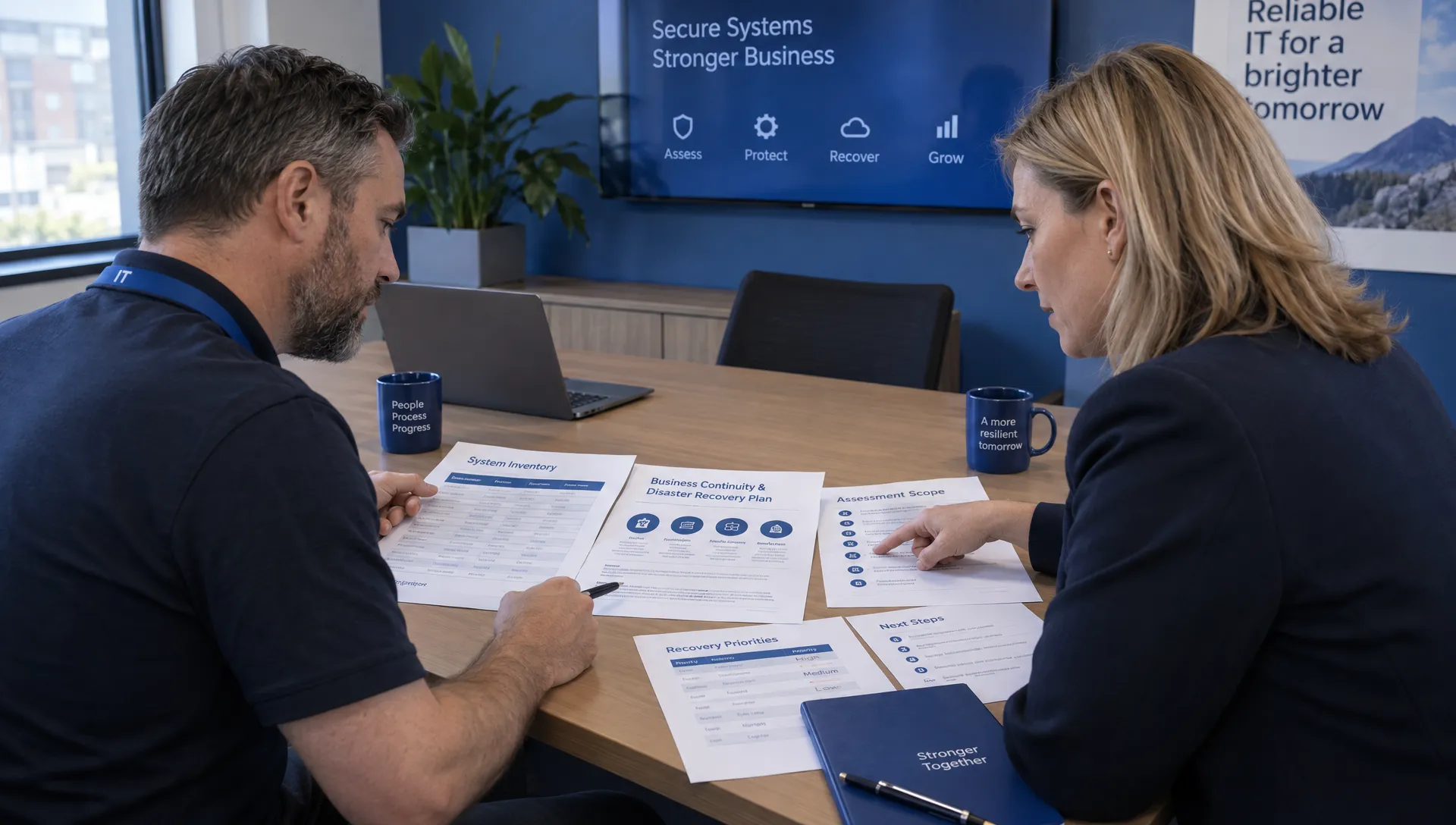
Start with a short statement of the business decision, then agree the evidence needed to support it. For example: “Assess whether our current access controls and recovery arrangements are suitable for the customer data we hold.”
A useful statement of work should cover:
- Scope and exclusions: Name the systems, locations, cloud services and third parties included, plus anything explicitly outside the assessment.
- Methods and evidence: Specify whether the work involves interviews, configuration reviews, sampling, scanning or hands-on testing.
- Deliverables: Agree an executive summary, evidence-backed technical findings and a prioritised action plan with proposed owners.
- Acceptance criteria: Define what makes the work complete, including the explanation of findings and treatment of disputed results.
- Follow-up: Confirm whether implementation advice, remediation verification or retesting is included and how extra work is authorised.
Ask for a suitably redacted sample report. You should be able to distinguish a business-critical finding from a lower-priority improvement and understand what action is required.
Also agree who receives the report. Detailed findings can expose sensitive information about weaknesses, so distribution and storage deserve the same care as the assessment itself.
Set firm rules for access and testing
Good cyber security consulting should reduce uncertainty without creating unnecessary operational risk. Give consultants named, time-limited accounts with the minimum access needed. Avoid shared administrator credentials and arrange to revoke access when the work finishes.
Agree how credentials, configuration exports and other sensitive material will be transferred and stored. Where personal data is involved, establish the parties’ data protection roles and any required contractual terms before sharing it.
Penetration testing needs written authorisation and clear rules of engagement. These should identify permitted targets, testing windows, prohibited techniques, escalation contacts and stop conditions if systems become unstable. Third-party and cloud-hosted services may require additional permissions or compliance with provider testing policies.
Do not treat an automated vulnerability scan as equivalent to a penetration test. Ask what human investigation and validation are included, which attack paths will be considered and how potential disruption will be controlled.
Finally, specify retention periods, deletion arrangements and whether subcontractors or external tools will receive your information. An NDA alone does not answer those questions.
Check credentials against the work you need
A qualification or badge is useful only if you understand what it demonstrates. Check current status through the relevant scheme or awarding body, confirm the organisation’s legal name and ask who will actually perform the work.
For cyber security consulting, company credentials and individual competence answer different questions. A provider may have a well-managed business without having the specialist experience your project requires.
| Credential or scheme | What it helps demonstrate | What you should not assume |
|---|---|---|
| Cyber Essentials or Cyber Essentials Plus | Certification against a defined set of baseline technical controls, with technical verification for Plus | That the holder is qualified to deliver every type of security consultancy |
| Cyber Advisor (Cyber Essentials) | Assured capability to advise on implementing Cyber Essentials controls | Blanket assurance for penetration testing, incident response or every compliance framework |
| CREST company accreditation | Assessment against requirements for specified accredited services | That every service sold by the organisation is within its accredited scope |
| ISO/IEC 27001 certification | An information security management system within the certificate’s stated scope | Proof of an individual consultant’s testing skills or the quality of a particular engagement |
The NCSC’s Cyber Essentials overview explains the baseline scheme. For specialist testing, check the relevant service accreditation through CREST rather than relying solely on a logo in a proposal.
Ask for examples involving organisations with similar systems, operational constraints and data sensitivity. Confirm professional indemnity cover where appropriate, and check that experience belongs to the people assigned to your engagement, not just the wider company.
Protect independence and separate security from compliance
A provider can assess your environment and help improve it, but its commercial interests should be visible. Ask whether it earns commission on recommended products, whether alternative approaches were considered and whether you can use another supplier for implementation.
Independent cyber security consulting is particularly valuable when leadership needs to challenge an existing design or validate significant remediation. If the assessor also sells the fix, request evidence for the recommendation and consider separate verification for high-impact changes.
Security and compliance work also overlap without being interchangeable. A technical review can support an assurance exercise, but it does not automatically establish that you meet every legal, regulatory or contractual obligation.
Where the trigger is a new obligation, certification deadline or transaction, this guidance on when to hire compliance consultants helps distinguish specialist external input from work that should remain internally owned. Define which questions require technical evidence, compliance interpretation or legal advice, then appoint the appropriate expertise.
Your business should retain ownership of risk acceptance. A consultant can explain options and consequences, but management must decide what to fund, defer or accept and record the reasons.
Measure progress after the report arrives
An engagement has not delivered its full value simply because findings have been presented. Agree a review point after implementation and check whether the evidence supports the claimed improvement.
For cyber security consulting, useful measures depend on the original objective. A recovery assessment might lead to a successfully tested restoration time. An access review might result in unnecessary privileges being removed and remaining exceptions formally approved.
Other evidence could include closure of verified high-risk findings, completion of an incident-response exercise or an accurate answer to a customer’s assurance request. Avoid judging success only by the number of vulnerabilities found: a longer list does not necessarily mean a more useful assessment.
Record unresolved issues, their owners and review dates. Ask for knowledge transfer so your team understands how to maintain the improvements. This reduces the chance of paying repeatedly to rediscover the same problems.
When consultancy is not the next purchase
If known basic controls are missing, begin by assigning responsibility and implementing them. Commissioning another broad assessment adds little when everyone already knows that unsupported devices, excessive access or untested backups need attention.
CIS’s practical tips for keeping your business secure provide a starting point for everyday safeguards. Specialist advice becomes more useful where the implementation is complex, the consequences are significant or independent validation is required.
You can also defer a wider review if no one has capacity to act on it, provided you understand and manage the resulting risk. A smaller, focused engagement addressing the most consequential uncertainty may be a better use of funds than an ambitious review with no implementation budget.
Frequently asked questions
Do we need a consultant if we already have IT support? Not necessarily. Check what your existing agreement covers and whether the team has the required expertise. External input is useful for a specialist question, independent assurance or a significant change, rather than duplicating work already being done well.
Should cyber security consulting be a one-off project or an ongoing arrangement? Use a defined project for a bounded decision, assessment or test. An ongoing arrangement can suit recurring advisory needs, but specify review frequency, deliverables and availability. Do not confuse access to advice with continuous monitoring or incident response.
How long should an engagement take? The timetable depends on scope, system complexity and access to evidence. Ask the provider to distinguish working time from elapsed time and identify dependencies on your staff. Agree an achievable schedule before committing to a customer or certification deadline.
Will a consultant guarantee that we cannot be breached? No. A credible provider should explain the limits of the assessment and the risks that remain. Testing is constrained by its scope and timing, while systems and threats continue to change.
Start with a decision, not a shopping list
Before requesting proposals, write down the business decision, the systems involved, the deadline and who will implement the outcome. That gives providers a fair basis for recommending work and makes proposals easier to compare.
CIS provides managed IT support, cyber security, backup and recovery planning, cloud services and co-managed support for UK organisations. Speak to CIS about your current arrangements and the specific gap you need to address, whether that calls for targeted specialist input, ongoing support or clearer ownership of existing controls.